Cervical Spine Normal Range Of Motion: Healthy MRI, ICD 10 Code, and Radiculopathy Insights
Understanding Normal Movements and Early Signs of Dysfunction
The cervical spine normal range of motion is essential for daily function and can be a key indicator of spinal health. Standard ranges, measured in degrees, help clinicians assess for issues such as radiculopathy or inflammation before advanced imaging like MRI is needed. Most healthy adults should have 80-90 degrees of neck rotation, 45 degrees of side bending, and about 50 degrees of forward flexion and backward extension. Recognizing deviations from these numbers early, in combination with symptoms like pain, numbness, or weakness, can guide both diagnosis and treatment options. Accurate identification and referral using the correct ICD 10 code for spondylosis are also vital parts of clinical documentation.
Clinical Assessment: Measurement Protocols and Healthy Variation
Initial evaluation of cervical spine health almost always starts with clinical measurement of range of motion (ROM). Clinicians use a goniometer or inclinometer to quantify flexion, extension, lateral bending, and rotation. In healthy adults, these normative values are used as baselines:
- Flexion: 50 degrees
- Extension: 50 degrees
- Lateral Bending: 45 degrees to each side
- Rotation: 80-90 degrees to each side
While minor variations exist between individuals, significant asymmetry or limitations may indicate joint dysfunction, radiculopathy, or even early spondylolisthesis. This quick yet thorough clinical process, often paired with a neurologic exam, sets the stage for imaging or other diagnostic steps when problems arise. The correct use of the ICD 10 code for spondylosis supports consistent documentation and insurance approval for further studies.
Role of Imaging: MRI and X-Ray for Cervical Spine Evaluation
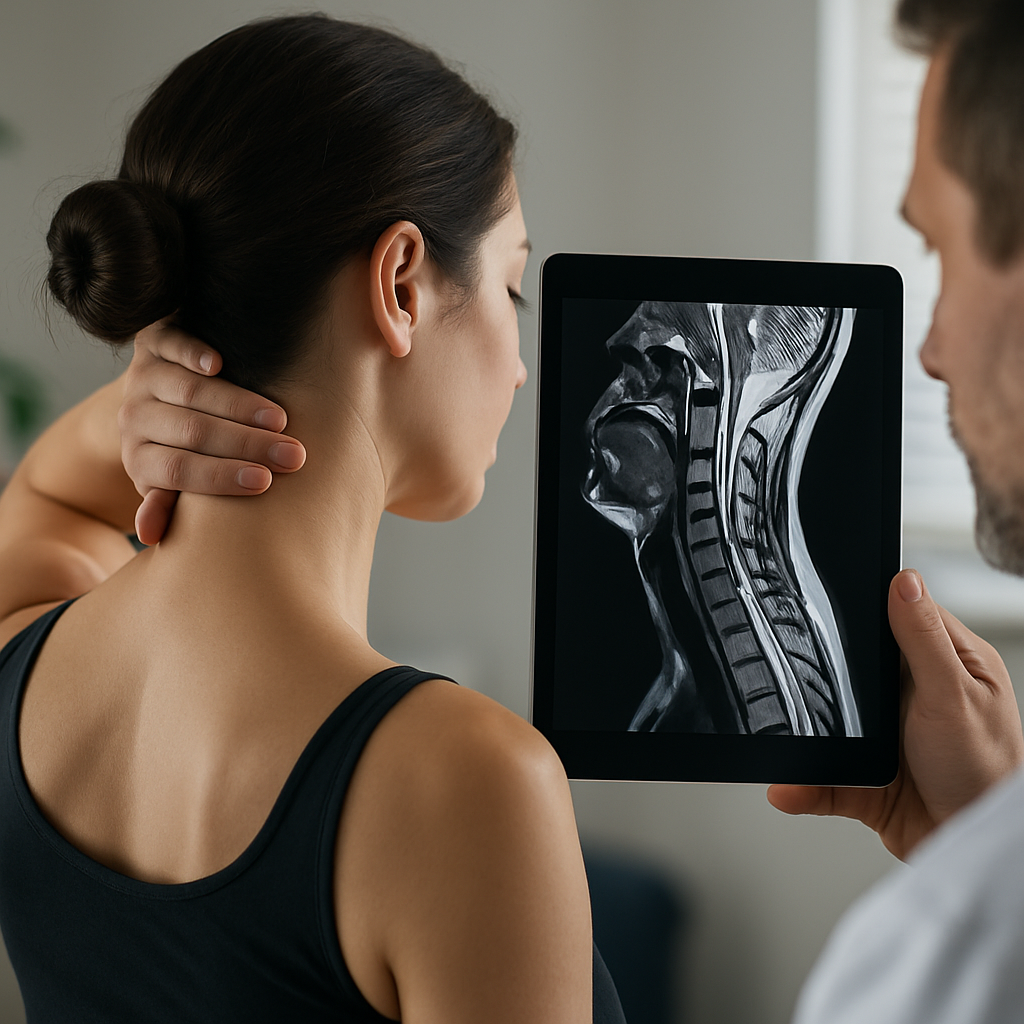
When motion restriction or neurological deficits persist despite conservative care, physicians often turn to imaging. MRI is the gold standard for assessing soft tissue, disc pathology, and nerve impingement, offering superior detail compared to standard X-rays. A healthy MRI of the cervical spine shows intact intervertebral discs, normal vertebral alignment, and no evidence of cord compression or abnormal signal changes. In cases involving trauma or significant instability, additional X-ray views—including oblique and flexion-extension positioning—can clarify the diagnosis and guide management strategies.
It is vital to interpret imaging findings in the context of the patient's symptoms and physical exam, as many adults exhibit age-related changes on MRI that do not cause clinical problems. Early disc degeneration or mild uncovertebral joint osteoarthritis are common and do not always require intervention unless they produce pain with radiculopathy or functional deficits.
Pathological Restrictions: Linking Radiculopathy and Range of Motion
Loss of motion is frequently associated with neurogenic symptoms, most commonly cervical radiculopathy. Patients may experience sharp, shooting pain down an arm, numbness, or muscle weakness, which correlate with nerve root compression. Decreased motion—especially with extension and rotation—may reproduce these symptoms or suggest the location of neural impingement. High-quality studies support a thorough examination, as both objective ROM measurements and highly sensitive clinical tests inform the need for further intervention.
Conservative care, including physiotherapy and manual therapy, can significantly improve range of motion and pain in many cases, as detailed in evidence-based reviews. If myelopathy signs—or progressive neurologic loss—are present, surgical intervention may be warranted after nonoperative measures are exhausted.
Functional restoration remains the primary goal, aligning with both patient-reported outcomes and objective data. Ensuring accurate ICD-10 documentation for spondylosis and related cervical spine conditions helps facilitate continuity of care across specialties.
Coding and Documentation: ICD 10 Code for Spondylosis
Accurate documentation is instrumental in guiding patient care and securing authorization for advanced diagnostics or interventions. The ICD 10 code for cervical spondylosis, M47.812 for example, pinpoints both the location and nature of spinal degeneration. Proper record-keeping aids in longitudinal tracking of ROM loss, the development of radiculopathy, and response to therapies or procedures.
When requesting imaging like a healthy MRI for clinical confirmation, precise ICD-10 and clinical details support appropriate resource use. This also allows seamless coordination between primary care, pain management, and rehabilitation services—optimizing patient experience and outcomes at every step.
Ultimately, the careful measurement of cervical spine normal range of motion, coupled with structured documentation and targeted imaging, enables early detection, personalized interventions, and better quality of life for those at risk of degenerative spine conditions.


Comments
Post a Comment